Feeling low after retiring or cutting down: you’re not alone

If you’re struggling right now, skip to getting support.
You looked forward to it for years. Then the day came, or your hours dropped, and instead of relief you felt flat. Perhaps a little lost. Perhaps low in a way you did not expect and find hard to explain to anyone else.
If that sounds familiar, you are not alone. Many people go through a dip after retiring or cutting down, and “retirement depression” is often the phrase they type when looking for answers. Semi Sweet is not a health site, and this is not medical advice. What we can do is explain why the change can hit hard, what tends to help in everyday terms, and where to find proper support if you need it.
Why retiring can leave you feeling low
Work gives us far more than a salary. Often we only notice how much when it stops.
- Role and identity. A job answers the question “what do you do?” When that goes, some people feel they have lost part of who they are. We explore this in from provider to what?
- Structure. The shape of the day used to be set for you. Without it, days can blur into one another, which is closely tied to retirement boredom.
- People. Colleagues are often most of our daily contact, including the small, easy conversations we did not know we relied on.
- Status and being needed. Being asked for your view, solving problems, being relied on. These quietly feed how we feel about ourselves.
- Purpose. A reason to get up, and something to aim at.
- Sudden change. Stopping all at once can remove every one of these on the same day.
- Money worries. Even with a plan, watching savings go out rather than wages come in can feel unsettling.
- Changes at home. More time together, or more time alone, shifts relationships in ways that take getting used to.
None of this is a sign of weakness. It is what happens when several important things change at once.
Retirement depression, or an ordinary dip?
For many people, feeling low after retiring is part of adjusting to a big change. It can look like:
- feeling flat, restless or at a loose end
- missing work, the people, or the person you were there
- a kind of grief for a chapter that has ended
- doubting whether you made the right decision
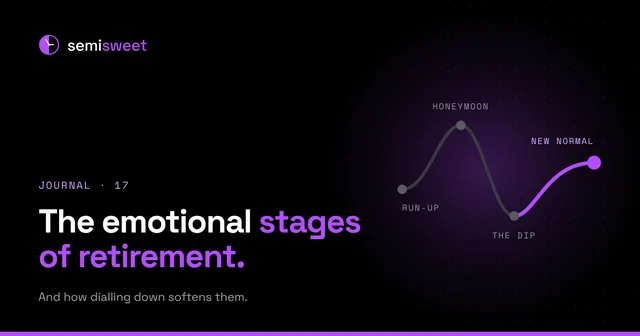
This is a common response to a big change. For many people it eases as new routines, roles and friendships take shape. It can take a while, and it rarely moves in a straight line. Good weeks and flat weeks often sit side by side for a time.
Sometimes, though, a low patch is more than a dip. These are general signs it may be worth getting support:
- low mood that lasts for weeks rather than days, or keeps coming back
- changes in your sleep, appetite or energy
- losing interest in things you used to enjoy
- withdrawing from friends and family
- drinking more to cope or to get through the day
- feeling hopeless, or that things will not get better
This is not a checklist for diagnosing anything, and only a professional can help you make sense of what you are going through. If some of it sounds like you, a good next step is to talk to a GP. Low mood is something they see often, and you do not need to have it all worked out before you book. You will find other routes to support further down.
What can help, day to day
These are everyday things many people find make the adjustment easier. They are not treatment, and they are not a substitute for support if you need it.
- Stay connected. Arrange to see people rather than waiting for it to happen. A regular coffee, a walk with a friend, a club or a volunteering role all count. Former colleagues are often glad to hear from you.
- Give the week some shape. A few fixed points, such as a morning routine, a weekly class or a standing plan with someone, can stop the days blurring. The week does not need to be busy, just held together.
- Move a little. A daily walk or some time outdoors helps many people feel steadier.
- Find some purpose. Something where you are useful, learning or making progress. There are plenty of ideas in what to do in retirement.
- Talk about it. Tell someone you trust how you are really feeling. Saying it aloud often takes some of the weight out of it, and the people close to you may be adjusting too.
- Give it time. A change this size usually takes months rather than weeks to settle. Be as patient with yourself as you would be with a friend.
Why dialling down can soften the change
Much of what makes retirement hard is that so many things stop on the same day. A glide changes that. If you reduce your working time gradually, perhaps to 80% and later to 60%, you keep some role, some colleagues and some structure while you build the rest of your life alongside.
It also gives you a chance to notice how you feel at each step. If a smaller share of work feels right, you can stay there for a while. If you miss more than you expected, you have learned something useful without making a change you cannot easily undo. Our guide to semi-retirement in the UK explains how a phased approach can work.
Dialling down will not suit everyone, and it is no guarantee against a low patch. But for many people, a slower change is an easier one to absorb.
Getting support
If you feel you might act on thoughts of harming yourself, or you are in immediate danger, call 999 or go to A&E.
If you are feeling low and it is not lifting, you do not have to wait it out.
- Your GP. A good first step if low mood has lasted or is affecting your daily life. They can talk things through with you and explain the options.
- NHS 111. In England, if you need urgent help, call 111 and select the mental health option, or use 111 online. In Scotland, contact NHS 24 on 111. In Wales, use NHS 111 Wales. In Northern Ireland, contact your GP or call Lifeline on 0808 808 8000.
- NHS Talking Therapies (England). You can usually refer yourself, without seeing a GP first, if you are 18 or over. Find your local NHS Talking Therapies service.
- Samaritans. Call 116 123, free from any phone, 24 hours a day, 365 days a year, to talk to someone who will listen. See samaritans.org.
- MoneyHelper. If money worries are part of it, MoneyHelper offers free, impartial, government-backed guidance online or on 0800 011 3797 (Monday to Friday, 9am to 5pm).
Be kind to yourself
Feeling low after a big change does not mean retiring or cutting down was a mistake. It means something that mattered has ended, and something new has not fully begun. That in-between stage can be uncomfortable. For many people it eases with time, and if it doesn’t, that is not your fault. Asking for help along the way is a strength, not a failure.
Questions people ask
Is it normal to feel depressed after retiring?
Feeling low, flat or lost after retiring or cutting down is common, especially in the first months. It is often an adjustment to losing role, routine and people at the same time, and for many people it eases as new routines form. If low mood lasts for weeks, or affects your sleep, appetite, energy or interest in things you used to enjoy, talk to a GP.
How long does it take to adjust to retirement?
There is no set timescale. Many people find it takes months rather than weeks, and it rarely moves in a straight line. Staying connected, giving the week some shape and dialling down gradually rather than stopping all at once can make the change easier to absorb.
Why do I feel lost after retirement?
Work often supplies identity, structure, social contact, status and purpose. When it stops, those can all go on the same day, which can leave you unsure who you are or what the days are for. For many people the feeling eases as new roles and routines take shape.
Where can I get help if I feel low after retiring?
Your GP is a good first step. In England you can call NHS 111 and choose the mental health option if you need urgent help, and you can usually refer yourself to NHS Talking Therapies. Samaritans are free to call on 116 123, day or night. If money worries are part of it, MoneyHelper offers free, impartial guidance. If you are in immediate danger, call 999 or go to A&E.
Guidance, not advice. This article shares general information and opinion, not medical or financial advice. If you are worried about your mental health, please talk to a GP or one of the services above.
Sources: NHS: Where to get urgent help for mental health · NHS: When to use 111 · NHS: Find NHS Talking Therapies · Samaritans: Contact us · MoneyHelper · NHS 111 Wales · Lifeline