From provider to what? Who you are when you work less

For a long time, many of us have had a simple answer to the question “what are you for?” We bring in the money. We keep the roof on. We make sure the bills are paid and the people we love are looked after. It is a role worth being proud of.
So when you start to think about working less, something unexpected can happen. The sums might add up. The idea of more time might sound lovely. And yet there is a quiet, nagging question underneath: if I am not the provider any more, then what am I?
That question deserves a proper answer, not a brush-off. Here is why it can feel so unsettling, and some gentler ways to think about it.
Why the provider role runs so deep
Providing is rarely just about money. Over the years it quietly picks up other jobs too.
- Status. Your work gives you a place in the world. It answers the “so, what do you do?” question at every gathering.
- Usefulness. Being needed feels good. Work offers a steady stream of problems only you can solve.
- Routine. The working week gives shape to your days, your energy and even your weekends.
- How others see you. Family, friends and neighbours may know you mainly through what you do and what you provide.
Take some of that away, even by choice, and it is natural to feel a bit adrift. That feeling is not a sign you are making a mistake. It is a sign that something important is changing.
Why it can hit some people harder
Anyone can feel this, whatever their background or circumstances. Plenty of women have been the main earner for decades, and plenty of couples have shared the load equally.
That said, many people of this generation grew up with a clear message that their worth was tied to what they earned and how hard he worked. Not everyone took that message on, and it is not a fixed rule. But if it landed with you, stepping back can feel less like a lifestyle change and more like losing your place. It can also be harder to talk about, because talking about it can feel like admitting something is wrong.
Nothing is wrong. You are simply being asked to grow a role you have held for a long time into something wider.
Providing in new shapes
Here is a reframe that many people find helpful. You do not stop being a provider when you work less. You start providing different things.
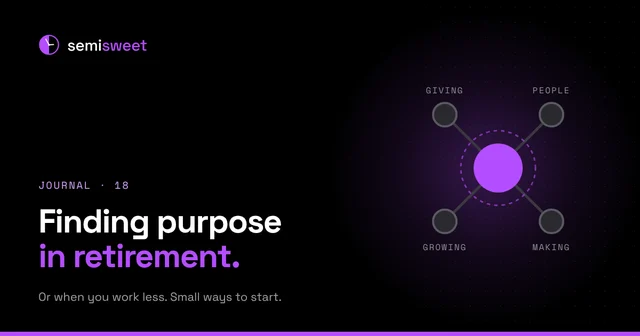
- Time. Being around for the grandchildren’s pick-up, the hospital appointment, the long lunch with an ageing parent. Time is often the thing your people have been missing most.
- Attention. Being properly present, rather than half there with one eye on your inbox.
- Experience. Decades of knowing how things work. That can be shared through mentoring, volunteering, a community role or helping a younger relative find their feet.
- Care. For others, and for yourself. Looking after your own health is a gift to the people who rely on you.
None of these show up on a payslip. All of them matter. And the years in which you can give them freely are not unlimited. Our healthy years calculator puts that gently into numbers, and time left vs money left explores the trade-off in more depth.
Who were you before your career got going?
Most of us were someone before the career got going. Think back to your late teens or early twenties. What did you do with a free afternoon? What did you talk about for hours? What did you want to be good at, just for the fun of it?
Some of those things will have faded for good reason. Others may simply have been put on a shelf because there was no time. Working less is a chance to take a few of them down and see whether they still fit.
You do not need to reinvent yourself. Often it is more like reconnecting with parts of you that were always there.
Small experiments while you are still working
The best time to explore this is before you cut down, not after. A few low-stakes ideas:
- Try one thing that is not about work. A class, a club, a regular walk with a friend. Notice how it feels to be known for something else.
- Practise a new answer. Next time someone asks what you do, lead with something other than your job title. It feels strange at first. That is the point.
- Offer time instead of money. Next time someone you love needs help, see what it is like to give an afternoon rather than paying for a fix.
- Use a holiday as a rehearsal. Spend a week at home without filling it with chores. What do you drift towards?
- Talk about it. With a partner, a friend or someone who has already dialled down. Saying “I am not sure who I am without work” out loud often takes the sting out of it.
Why a gradual glide helps
Stopping work all at once asks your identity to change overnight. Dialling down gradually, to perhaps 80% and later 60% of your time, gives it room to catch up.
You keep some of the status, usefulness and routine that work provides, and your colleagues still rely on you. Meanwhile the other parts of your life have space to grow. By the time the working part gets smaller, the rest is already there to hold you.
A glide also keeps some income coming in, which can ease the specific worry of no longer providing financially. If you want to see what different shares of your time might mean for take-home pay, the part-time pay calculator is a good place to start, and our semi-retirement guide covers the wider picture.
If this piece struck a chord, scared to retire? The fears nobody talks about looks at identity alongside the other worries that tend to come with it.
When the feeling sticks around
A wobble when you first picture life with less work is normal. It usually settles as new routines take shape. If low mood lingers, or starts affecting your sleep, appetite or relationships, it is worth talking to your GP. That is not a failure of the plan. It is part of looking after yourself through a big change.
Questions people ask
Why do I feel lost when I think about retiring?
Work often supplies status, usefulness, routine and a ready answer to the question of who you are. When you picture that going, it is natural to feel unsettled. The feeling is usually about identity rather than a sign you are making the wrong choice.
How do I find purpose after working less?
Start small while you are still working. Try one or two things that used to matter to you, notice what gives you energy, and widen your idea of providing to include time, attention, experience and care, not just income.
Is it normal to lose your identity in retirement?
Yes, many people feel a loss of identity when work shrinks or stops. Cutting down gradually gives your sense of self time to adjust, so the rest of your life can grow as the working part gets smaller.
What if I feel low after cutting down my hours?
A period of adjustment is common, and it often eases as new routines settle. If low mood lasts for more than a couple of weeks or affects your sleep, appetite or relationships, it is worth talking to your GP.
Guidance, not advice. This article shares general information and opinion, not financial advice. For free, impartial help, visit MoneyHelper.