Too much for help, too little to stop: the squeezed middle

There is a group of people who rarely make the headlines. They are not struggling enough to qualify for much help, and not comfortable enough to stop work when they would like to. They pay their way, keep things ticking over, and quietly wonder how long they can keep going at full pace.
If you are in your 50s on a middle income, this might sound familiar. This piece is for you. It is not a complaint about anyone. It is an attempt to describe a squeeze honestly, and to suggest that the choice is not as stark as it is often made to seem.
Too much for help
Much of the support in the system is, sensibly, aimed at those who need it most. That means a steady salary often puts you just above the line for many forms of help. You are doing fine on paper.
But “fine on paper” can hide a lot. A mortgage that still has years to run. A car that will need replacing. Bills that rise faster than pay rises. Being above the line does not always mean having room to breathe. It simply means the job of making it work falls to you.
Too little to stop
At the same time, many middle earners reach their 50s with pension pots that are respectable but not large. Perhaps there were years of lower contributions while children were small, a career break, a period of self-employment, or simply a lot of other things that needed paying for first.
So the question “Could I stop at 60?” often gets an uncomfortable answer. Not “no, never”, but “not without the money running thin”. For a sense of what different lifestyles cost, the Retirement Living Standards suggest a single person needs around £13,900 a year for a minimum lifestyle and £32,700 for a moderate one. Our how much do I need to retire tool sets out what that could mean for you.
The sandwich in the middle
For many people at this stage, the squeeze is not only financial. It is about time and energy too.
The phrase “sandwich generation” describes people who are supporting their own children and helping ageing parents at the same time. The children may be older now, but still need help: with university, a first rented flat, a deposit, or just a place to come home to. Meanwhile parents may need lifts to appointments, help with paperwork, or more care as the years go on.
None of this is a burden in the sense of being unwelcome. Most of us want to be there for the people we love. But it does mean that the years many of us imagined as a gentle run-in to retirement can turn out to be some of the busiest of our lives. Full-time work on top of all that is a lot to carry.
A longer gap to bridge
Then there is the State Pension. It is currently paid from 66, and that is rising to 67 for anyone born between 6 March 1961 and 5 April 1977. Current law also sets a later rise to 68, with the timing kept under review. Check your own date with our pension age checker.
Meanwhile, the earliest you can usually take a private pension is 55, rising to 57 from 6 April 2028. The space between those two ages is the gap that someone stopping work early has to fund alone. If your private pension age is 57 and your State Pension age is 67, that is ten years. Stop at 60, and it is still seven.
For someone with a large pot, that may be manageable. For a middle earner, ten years of living costs from one modest pension is a lot to ask.
Why all-or-nothing does not fit
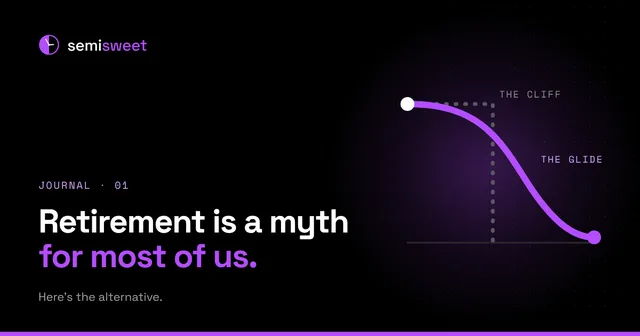
The traditional picture of retirement is a single day: a card, some kind words, and then you stop. Before it, full-time. After it, nothing.
That model works best for two groups. Those with enough saved to stop whenever they like, and those who are happy to work full-time right up to State Pension age. The squeezed middle often falls between the two. Stopping completely feels out of reach. Carrying on at full pace for another decade or more, while caring for others and watching the healthy years tick by, can feel like too much.
It is worth remembering that healthy life expectancy at birth in the UK is about 61 years, according to the ONS. That is an average, not a forecast for you. But it is a gentle reminder that the years in your late 50s and early 60s are precious, and that waiting until 67 or 68 to have more of them back is a real trade. We explore that idea more in retirement is a myth.
The middle path: dialling down
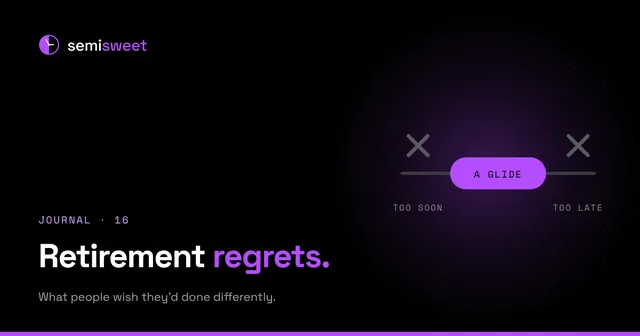
If all-or-nothing does not fit, there is another option that gets far less attention: working less, not stopping. Dropping to 80% or 60% of your time, through fewer or shorter days or a lighter role.
Here is how the numbers can look. Take someone earning £45,000 a year in England, paying 5% into a pension through relief at source. Dialling down from 100% to 80% of their hours would cost about £510 a month in take-home pay. Going to 60% would cost about £1,020 a month, while still keeping about 64% of their take-home pay.
That last number surprises people. Working 60% of the time does not mean taking home 60% of the pay, because of the way tax and National Insurance work. On a smaller salary, a bigger share falls within your tax-free personal allowance. You can try your own figures with our part-time pay calculator.
Dialling down can help the squeezed middle in a few ways:
- Earnings carry on, so your savings have fewer years to cover on their own.
- You may still be building pension savings and National Insurance years while you work.
- You get time back now, when it may matter most, for family, health and the things you have been putting off.
It is not right for everyone, and it is not always possible. But every employee in Great Britain can request flexible working from day one of a job, so it is at least a conversation worth having. Our semi-retirement guide walks through the options and the trade-offs.
A kinder way to see it
If you feel squeezed, it is not because you have done anything wrong. You have worked, saved what you could, and looked after people. The system was simply not designed around the shape of your life.
The good news is that you do not have to choose between “keep going at full pace until State Pension age” and “stop and hope it lasts”. There is a middle path, and it was made for people in the middle. If the pressure is affecting your sleep or mood, talking to your GP is worthwhile too. And if you want free, impartial help understanding your pensions, MoneyHelper is a good place to start, and Pension Wise offers free guidance if you are 50 or over with a defined contribution pension.
Rules are general, and your circumstances are your own, so check the details for you before making any decisions.
Questions people ask
What is the squeezed middle?
It is a common phrase for people on middle incomes who earn too much to qualify for most targeted support, but not enough to feel financially comfortable. In later working life it often means having a pension that is too small to stop work early.
What is the sandwich generation?
The sandwich generation describes people, often in their 40s and 50s, who are supporting their own children and helping ageing parents at the same time, with money, time or both.
Can I afford to retire at 60 on a middle income?
It depends on your pensions, savings, outgoings and when your State Pension starts. For many people the State Pension does not begin until 67, so stopping at 60 means funding several years alone. Check your pension ages and State Pension forecast first, and consider whether working less, rather than stopping, could bridge the gap.
What is semi-retirement?
Semi-retirement means working less before you stop altogether, for example through fewer or shorter days or a lighter role. Your earnings carry on while your savings have fewer years to cover.
Guidance, not advice. This article shares general information and opinion, not financial advice. For free, impartial help, visit MoneyHelper.
Sources: GOV.UK: State Pension age timetable · GOV.UK: Flexible working · ONS: Health and life expectancies · MoneyHelper: Pension Wise